Tuesday, May 12, 2015

Taking the L.E.A.D. - The Creative J Goes to Washington


Rachel Valdez
Certified Advertising Specialist
The Creative J

Next week, May 20-21, 2015, Rachel Valdez of The Creative J will join the Promotional Products Association International in Washington, D.C., to meet with members of Congress and federal agencies for the sixth annual PPAI L.E.A.D. (Legislative Education  and Action Day). Rachel was selected as one of only three members from the Midwest region to represent the industry!

The PPAI L.E.A.D. is a gathering of PPAI leadership, members and industry professionals from around the country who come together in Washington, D.C. (in-person and virtually) to educate Congress on industry-critical issues as well as the power, impact and job-generating value of promotional products. PPAI is the world’s largest and oldest not-for-profit association serving more than 11,000 corporate members of the $19.8 billion promotional products industry which is comprised of more than 33,741 businesses and a workforce of nearly 500,000 professionals.


During PPAI L.E.A.D., nearly 78 advocates from 30 states will conduct more than 250 meetings with senators, congressional representatives and their legislative staffs on Capitol Hill.


One issue this delegation will be addressing is the proposal by congress to treat advertising expenses as only 50% deductible during the year they are spent, with the remaining 50% spread out over five or ten years. Not being able to claim items such as print and media advertising, business cards, website development, promotional products and other marketing and advertising items will greatly affect how businesses operate. In addition, it would make a major impact on all areas of the advertising community. 

For more on how promotional products and advertising are a vital part of the economy, and how current and proposed legislation can impact not only this specific industry, but the businesses which rely on it as a vehicle for their own success, you can download and read the PPAI Legislative Agenda for 2015.

Friday, May 1, 2015

Still King – Printed Calendars

In a world dominated by electronic devices, does anyone still use an old-fashioned printed calendar?

You bet they do!

The printed calendar still holds an important place in both homes and businesses, which creates an advertising opportunity with great ROI.

Just a few stats, according to a 2011 PPAI study:

1981 – 98% of homes & 100% of businesses had a printed calendar.
30 years later: – 79% of homes & 78% of businesses still had printed calendars.

1981 – 70% of home and 80% of business calendars contained advertising.
30 years later: – 61% of home and 76% of business calendars were still marketing products.

1981 – Every home had nearly 4 calendars and every business had 2.5 calendars.
30 years later: – Homes had 3 and businesses had 2.

As you can see, over the course of 30 years, not a lot changed. Sure, numbers on printed calendars have gone down, but they are still used in a high percentage of homes and businesses.


Looking to reinforce your organization's name and service or mission? With a calendar, the average person will look at that calendar, and your imprint, 2 - 10 times PER DAY.

Let's take an average of those, at 6 times per day, times 5 business days per week, times 50 weeks per year (we'll subtract 2 weeks of vacation time!). That makes 1500 impressions per year. 1500 times your customers will see your name and logo. Pretty good use of advertising dollars, huh?!

If you spend an average of $3.00 per calendar, that less than 1¢ per impression, per year! It's hard to beat that stat with any other type of advertising or marketing.


Monday, April 20, 2015

Custom Apparel – Makin' It Your Own

If you're looking for a truly unique way to outfit your employees and make your organization's apparel program really stand out, consider custom. With as few as 48 pieces, you can create a totally unique look which reflects your colors and your style.

With our reliable manufacturers, you now have the option to create custom apparel which is delivered in 35-45 days. Just let us know what types of apparel you are interested in, we'll get you electronic mock ups of several ideas for your review. (Click here to see sample mockup presentation.)

Then just review the presentation and make tweaks where needed. Once you've decided on the details, you'll receive a fully-decorated production sample for final approval.


The options are endless. Pick your colors, fabrics, styles and decoration to create one-of-a-kind apparel you won't find anywhere else.

What better way to really set yourself apart from the rest!

Since the apparel is created and sewn from the ground up, you now have more options than just your standard left chest decoration. And what's really great, pricing is still very similar to good-quality stock apparel.


Friday, April 3, 2015

Keepin' It Cool - What Type of Coolie Works Best?

Confused about the types of beverage insulators out there? Wonder what's the difference between scuba and neoprene? Wonder why they call it scuba when diving suits are made out of neoprene?

Here's a quick rundown on the types of coolie materials commonly used:


Scuba: Open cell polyurethane foam with a polyester fabric on one side and tricot on the other.

Neoprene: Closed cell rubber-based product with polyester or nylon fabric on both sides.

The photo shows the scuba on the left, neoprene on the right.

Now, what does that mean? In a nutshell, open cell has more air pockets and is thus, less insulating. Since closed cell is much denser, it blocks transfer of heat much better, keeping your beverage cooler for longer.

So why choose scuba over neoprene? Price. It was developed as a cheaper alternative to neoprene, but the tradeoff is it won't insulate as well.

So when choosing an insulator, the decision is yours – less expensive, but won't perform as well, or spend a little more for a better product.

Monday, March 16, 2015

Umbrellas 101

It's that rainy time of year coming up, and the perfect time to think about umbrellas as marketing tools. Whether it's for golf outings or personal use, umbrellas can't be beat for the length of time the recipient will hold onto them and the marketing exposure they offer.

When in the market for umbrellas, the following things should be kept in mind:

Stick or Folding:
Stick umbrellas are much stronger than folding ones. Each joint in a folding umbrella which allows you to fold it down creates a point of weakness. You sacrifice strength for convenience.

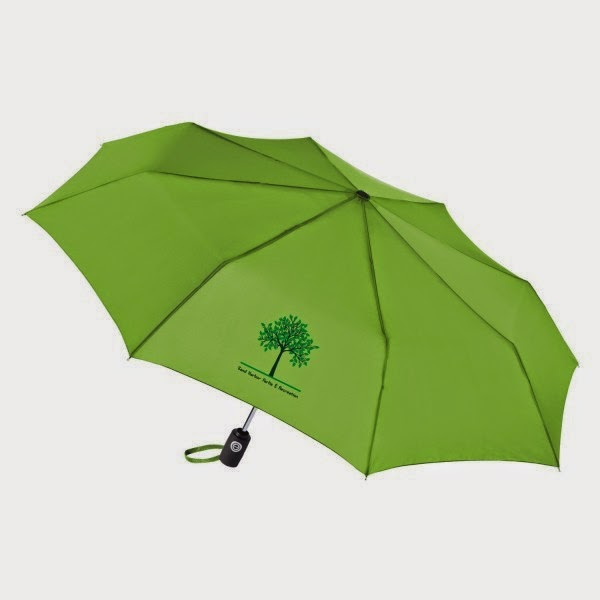
Click here to view our favorite folding umbrella - Totes Auto Open/Close Umbrella

Ribs and Frame:
The ribs of an umbrella are the rods which spread out and attach to the canopy. Coated ribs will better protect against rust and corrosion. The ribs and frame are usually made up of aluminum, steel or fiberglass. Aluminum is the least expensive, but also the most likely to break and bend. Steel, while much stronger, is more rigid and can break at the rivets in a strong wind. Fiberglass, though pricier, is stronger and flexible, making it better able to handle very strong gusts.

Vented Canopy:
A vented canopy, or double canopy, is common on golf umbrellas due to their normally larger arc size. The vent allows wind to pass through the canopy rather than invert it. Some smaller umbrellas are now available vented.

The Gustbuster is the umbrella of choice for touring pros. It can withstand up to 60mph gusts without inverting. It also comes with a lifetime warranty. Check out more details here:  GUSTBUSTER


Fiberglass or Metal:
As discussed above, fiberglass offers more flexibility in wind gusts, decreasing the chances of damage to the umbrella. Another advantage of fiberglass is that it does not conduct electricity, making it much safer in a lightning storm.


Some fast facts about umbrellas:

  • average imprint area is 7"x5" and can go up to the entire umbrella canopy -- great advertising space!
  • golf outings are perfect for umbrellas - cheaper than golf balls and don't end up at the bottom of the lake!
  • great item for gift with purchase
  • rule of thumb:  everyone needs at least 3 umbrellas - it's a personal accessory
  • perfect appreciation gift - the recipient will hold on to it for years

Thursday, March 5, 2015

Pop Your Pocket - Not Your Basic Tee


Looking for a new look for your basic tshirt? Pop Your Pocket!


With our Pop-Your-Pocket program, you combine a tshirt color and a pocket color along with a variety of decorating techniques for a truly custom look.


Decoration can be applied on top or beneath the pocket, as well as on or above. By combining unique color combinations along with a variety of screenprint techniques and inks, you'll have a tshirt like no other.

Minimum order is 72 pieces. Contact us for a free virtual concept.


Monday, March 2, 2015

Golf Shirts - Understanding Fabrics

In the very popular category of golf and polo shirts, you'll find a wide array of fabrics, technologies and styles. Below is a quick guide to the most popular types of fabrics and features you'll find in this apparel category:

Fabric Types

Cotton - This universal fiber comes in many varieties, in order of softness:
Carded: Process which removes the debris in the fibers.
Combed: Shorter fibers are removed, leaving a higher-quality, softer cotton.
Ring-Spun: Fibers are spun into yarn, creating a softer, stronger thread.
Pima: Premium cotton which is very fine, lustrous and strong

Microfiber - Ultra-fine fibers which make a very soft, silky fabric.

Polyester - This fabric has become extremely popular for it's excellent wear and quick-drying properties. 

Spandex - Stretchy fiber which is now often added to materials to create a bit of "give."

When it comes to polo shirts, the trend is definitely towards polyester or poly blends which also incorporate various technologies.


Finishes or Added Features:

Moisture Wicking - moves moisture away from the skin and allows it to pass to the surface for evaporation, keeping the wearer cooler in hot temperatures.

UV Protection - Protects the fabric from fading and the wearer from harmful UV rays.

Snag-Resistant - Resists snagging and thread-pulling

Odor-Fighting or Antimicrobial - Resists odor caused by body bacteria and increases the garment life.


Jacquard Knit
Ottoman Knit
Pique Knit
Mélange


Weaves or Styles

Jacquard - Intricate pattern woven into the fabric, typically with two or more colors

Ottoman - Tightly woven horizontal raised rib texture

Drop-Needle - Knit fabric with vertical lines within the cloth

Herringbone - Zig-zag pattern knit into the fabric

Mélange - Mix of different colors knit together to create a heathered look

Nailhead - Jacquard knit with a design similar to small nail heads

Pique - A knitting method that creates a fine textured surface similar to a waffle weave